
Sir C. V. Raman Biography: Raman Effect, Nobel Prize, Invention, Early Life & Achievements
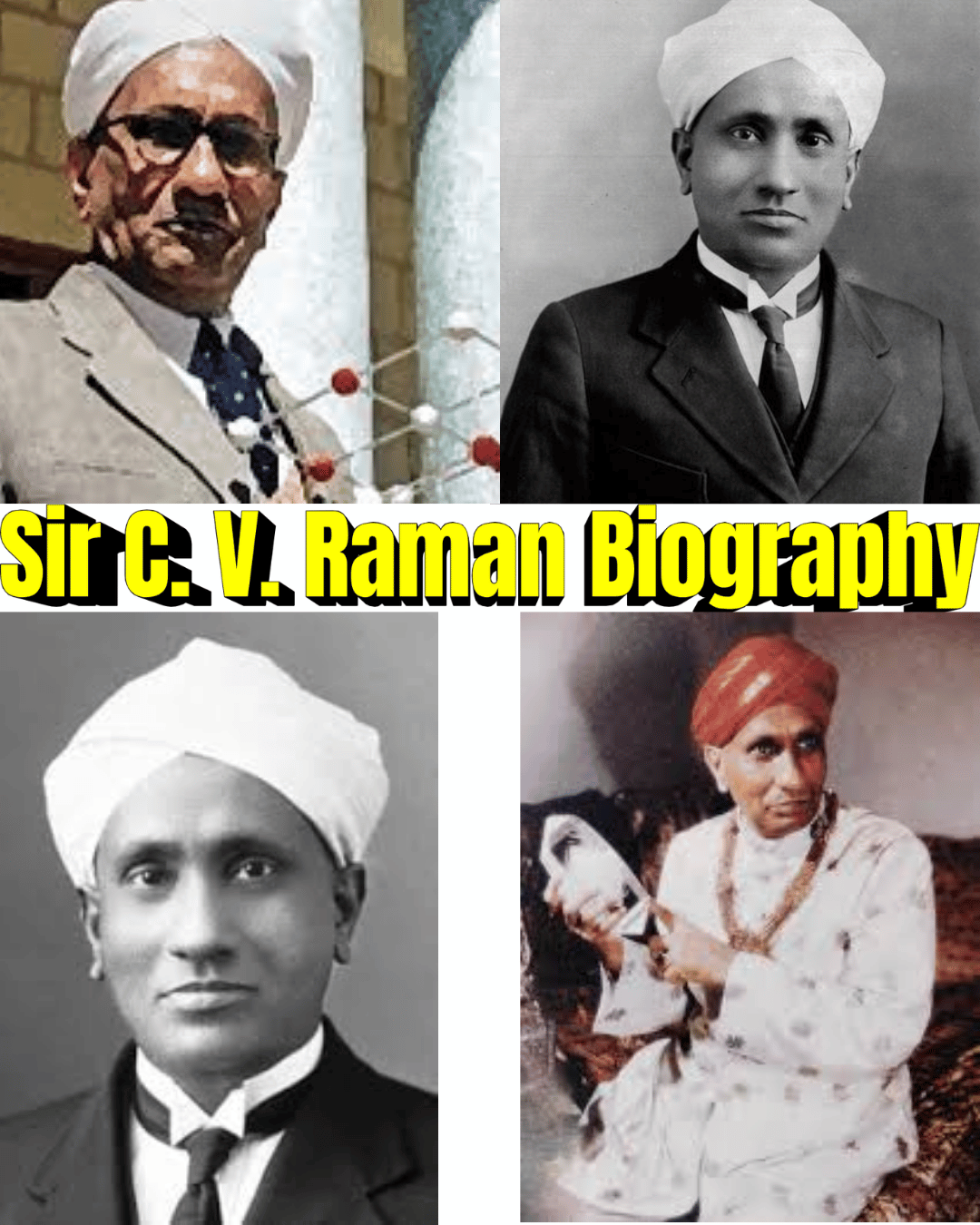
The Sir C. V. Raman biography highlights the life and scientific achievements of C. V. Raman, one of India’s greatest scientists and the first Asian to win a Nobel Prize in Physics. He is best known for discovering the Raman Effect, a groundbreaking contribution to the field of light scattering and spectroscopy.
His work placed India on the global scientific map and continues to influence modern physics and chemistry.
Sir C. V. Raman Biography
| Field | Details |
|---|---|
| Full Name | Sir Chandrasekhara Venkata Raman |
| Date of Birth | November 7, 1888 |
| Birthplace | Tiruchirappalli, Tamil Nadu, India |
| Nationality | Indian |
| Profession | Physicist |
| Famous For | Discovery of the Raman Effect |
| Nobel Prize | Physics (1930) |
| Date of Death | November 21, 1970 |
Early Life and Education
Sir C. V. Raman was born on November 7, 1888, in Tiruchirappalli, Tamil Nadu. His father was a lecturer in mathematics and physics, which inspired Raman’s early interest in science.
He was a brilliant student and completed his Bachelor’s degree at Presidency College, Madras (now Chennai) at a very young age. He later earned a Master’s degree in Physics with top honors.
Even as a student, he published research papers in international scientific journals, showing exceptional talent in physics.
Early Career
Although Raman initially joined the Indian Finance Department as a civil servant, his passion for science remained strong. During his time in Calcutta (now Kolkata), he conducted research at the Indian Association for the Cultivation of Science.
Eventually, he left government service to become a full-time professor of physics at the University of Calcutta.
Discovery of the Raman Effect
In 1928, Sir C. V. Raman made his most important discovery—the Raman Effect.
The Raman Effect explains how light changes direction and wavelength when it passes through a transparent substance. This discovery proved that light can be scattered and shifted in energy when interacting with molecules.
For this groundbreaking discovery, he was awarded the Nobel Prize in Physics in 1930, making him:
The first Asian Nobel Laureate in Science
The first Indian to win a Nobel Prize in Physics
Academic Leadership
Raman later became the Director of the Indian Institute of Science (IISc) in Bangalore. He also founded the Raman Research Institute in 1948 to promote scientific research in India.
He strongly believed that India should develop its own scientific talent and institutions rather than depend on foreign expertise.
Awards and Honors
Throughout his lifetime, Sir C. V. Raman received many prestigious awards, including:
Nobel Prize in Physics (1930)
Bharat Ratna (1954), India’s highest civilian award
Knighted by the British government in 1929
His birthday, November 7, is celebrated in India as National Science Day in honor of the discovery of the Raman Effect.
Contribution to Science
Raman’s discovery laid the foundation for Raman Spectroscopy, a technique widely used today in:
Chemistry
Physics
Medicine
Forensic science
Material science
His research opened new pathways in understanding molecular structures and light behavior.
Personal Life
Sir C. V. Raman married Lokasundari Ammal and had two sons. Despite his fame, he lived a disciplined and simple life focused on research and education.
He remained actively involved in scientific work until his final days.
Death and Legacy
Sir C. V. Raman passed away on November 21, 1970, in Bangalore, India.
His legacy lives on through:
Raman Research Institute
National Science Day celebrations
Continued global use of Raman spectroscopy
Inspiration to generations of scientists
He is remembered as one of the greatest scientists in Indian history.
Conclusion
The Sir C. V. Raman biography tells the inspiring story of a brilliant Indian physicist whose discovery revolutionized modern science. His dedication to research and education helped shape India’s scientific future and earned him global recognition as a Nobel Laureate.
Frequently Asked Questions (FAQs)
1. Who was Sir C. V. Raman?
Sir C. V. Raman was an Indian physicist who discovered the Raman Effect and won the Nobel Prize in Physics in 1930.
2. What is the Raman Effect?
The Raman Effect is the scattering of light that results in a change in wavelength when light passes through a substance.
3. When did C. V. Raman win the Nobel Prize?
He won the Nobel Prize in Physics in 1930.
4. When was Sir C. V. Raman born?
He was born on November 7, 1888.
5. Why is National Science Day celebrated in India?
It is celebrated on November 7 to honor Raman’s discovery of the Raman Effect.
